Content note: contains some offensive historical language about disability.
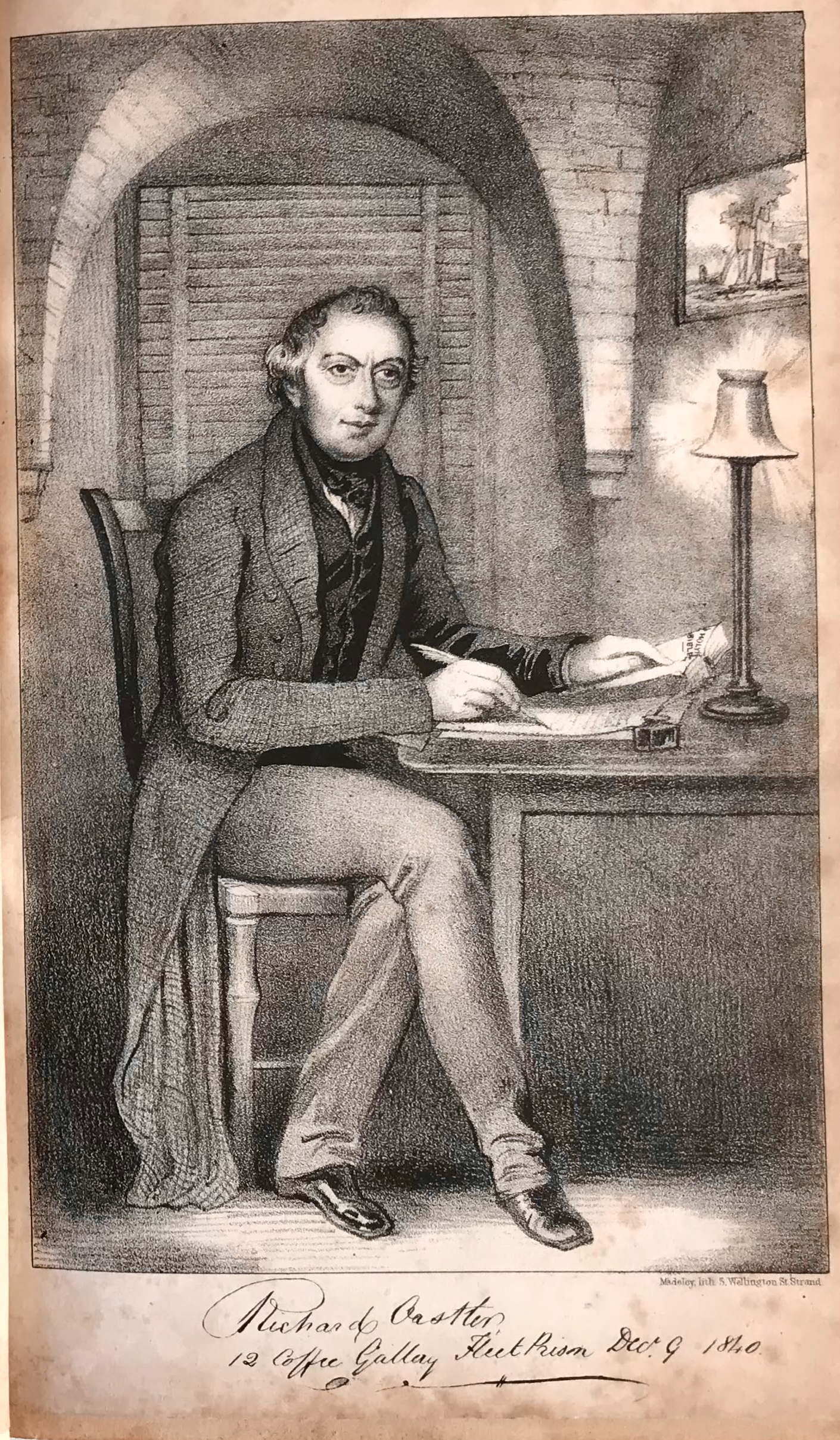
The pencil sketch above depicts a well-dressed man. He is seemingly emanating light himself, as well as the illumination of the oil lamp on his desk as he carefully writes notes. His eyes are slightly out of focus. His furniture, though minimal, is respectable. This is Richard Oastler in the Fleet Prison, London, in 1840.
Richard Oastler was born in Leeds in 1789, one of ten children to Robert Oastler, a cloth merchant. As a child, one of Oastler’s brothers died in a factory fire at Marshall’s Mill, an incident which haunted him. His Methodist family were already staunch abolitionists when the Transatlantic Slave Trade ended in Britain in 1807, but it was in 1830, when he succeeded his father’s post as steward of the Thornhill estate of Fixby Hall, near Huddersfield, that he was radicalised further. Six handloom weavers walked from Huddersfield to speak to Oastler’s sympathetic ear about the condition of textile factory workers in West Yorkshire, and especially, the working conditions faced by young children. Their accounts being corroborated by Oastler’s friend and reforming factory master John Wood, he wrote the first of several incendiary letters to the abolitionist paper the Leeds Mercury, edited by his school acquaintance Edward Baines Jr., entitled ‘Slavery in Yorkshire!’. You can read an excellent overview of Oastler’s life on the Chartist Ancestors website.
What fascinates me about Oastler is the way that this shining awakening to activism – despite his otherwise Tory principles – resulted in his being celebrated as a liberator, a proto-leader, and specifically Yorkshire political celebrity by working-class activists in the north of England. A longitudinal view of Oastler supports this; with the gift of hindsight we know that he spent a great deal of his own money supporting textile workers’ causes, especially campaigning on behalf of children (and encouraging children to go on strike!), to the point that he was arrested for debt by his Whig employer, Thomas Thornhill Jr. It was this moment, Christmas 1840, that he was taken not to the debtors’ wing of York Castle Gaol – where his wife Mary, adopted daughter Martha, and friends could have easily have visited him – but to the Fleet Prison in Farringdon, London. Oastler’s writings, continuing his tradition of appearing as an impassioned correspondent to papers in Leeds, as well as the radical Northern Star, had reached a national audience (which one suspects was the true reason for Thornhill’s decision to pursue arrest). His letters and speeches were republished as pamphlets, offering his voice a form of virtual geographic mobility separate from his body. He continued this tradition while imprisoned, establishing an unstamped paper, just as other imprisoned radicals like William Cobbett had done generations before. It enabled him to continue communicating with his friends and supporters, while also being a fundraising endeavour to pay off his debt.
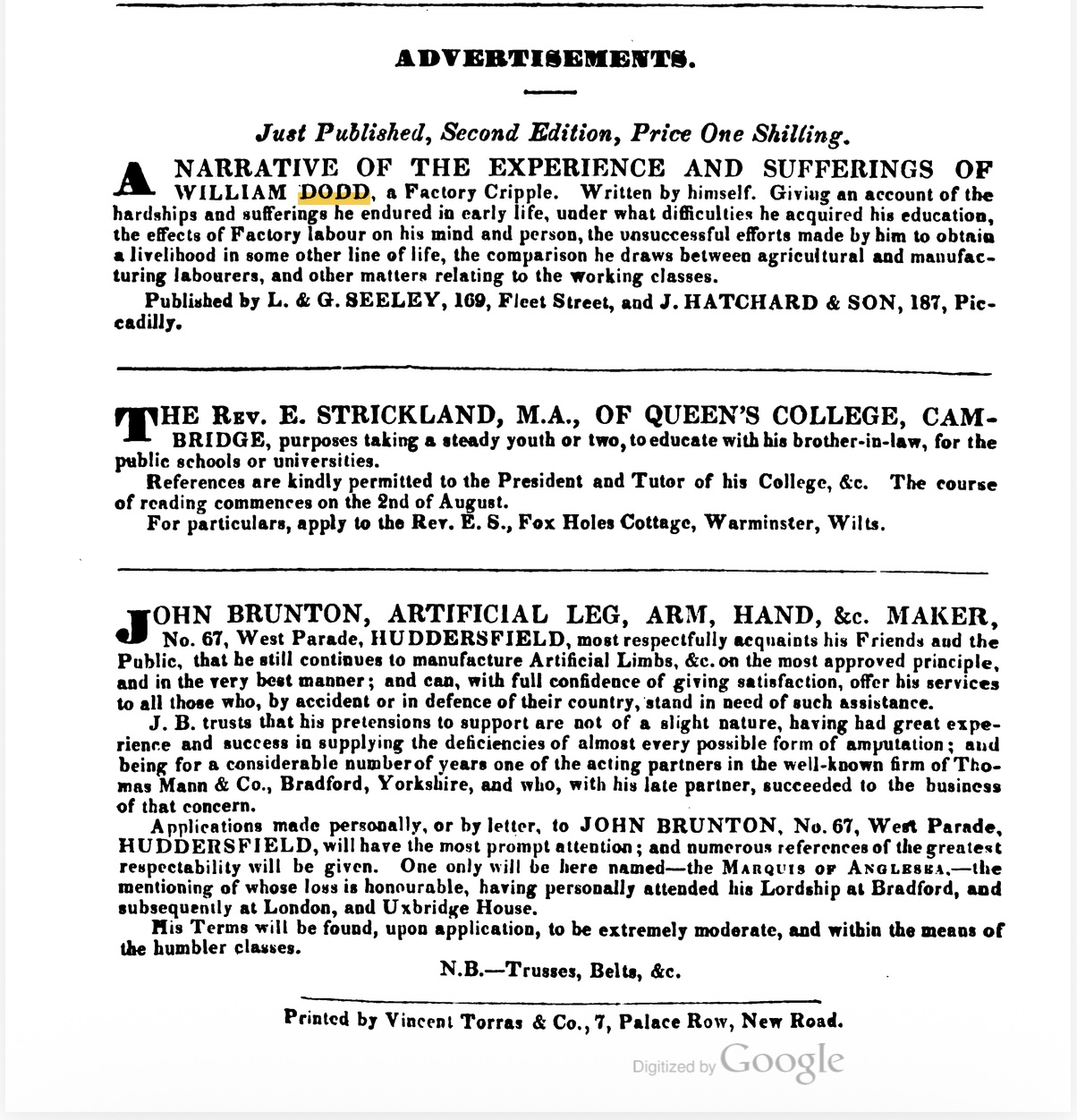
The Fleet Papers is an under-researched title in radical history. Granted, it didn’t have a large reach, though it’s hard to find numbers of sales. It was advertised and reviewed heavily in the Northern Star, but there seem to be more personal reasons behind this: publisher-turned-editor Joshua Hobson had been one of those Huddersfield handloom weavers who visited Oastler back in 1830, and maintained a loyalty to him. The Fleet Papers does, however, have an interesting place in the history of labour and disability. Accounts of William Dodd, the self-proclaimed ‘factory cripple’, first appear in Oastler’s journal, before Oastler’s friend Lord Ashley supported Dodd and his wife by helping to publish the Narrative of his life. One can trace Dodd’s development through the pages of the Fleet Papers, even through the advertisements (see below). His celebrity was built from the platform of Oastler’s own.
Another aspect of Oastler’s Fleet Papers which makes it an interesting source to historians of politics and celebrity is his ‘Rent-roll’, a deliberate pun on his duties as steward of Fixby Hall. The ‘rents’ he collects are, in fact, lists of gifts sent to him by friends and supporters. These range from monetary donations through to home-cooked treats.
My article for Northern History explores these aspects of Oastler’s radicalism and his rise to celebrity status. Oastler was a man of contradictions. Matthew Roberts has written about pinning down Oastler’s definition of ‘Tory Radical’ (although to twenty-first century readers this may seem an oxymoron). He was able to survive through maintaining connections across social classes: while he was playing the part of gentleman running the Fixby Hall estate, he was importantly still a servant. Indeed, Oastler’s financial salvation came from a combination of his friends who were relatively wealthy industrialist MPs and his working-class supporters donating what they could spare. Attempting to find consistency across his political philosophy can be an infuriatingly difficult task. For that reason, Oastler and his epistolary activism are very much worth revisiting.
Sources and further information:
- Emily Zobel Marshall, ‘Black Abolitionists in Yorkshire: Cunning better than Strong’, Leeds Beckett University Blog, 4 October 2021. https://www.leedsbeckett.ac.uk/blogs/school-of-humanities-and-social-sciences/2021/10/black-abolitionists-in-yorkshire/.
- Ruairí Lewis, ‘Slavery in Yorkshire’, The Secret Library, 30 June 2022. https://secretlibraryleeds.net/2022/06/30/slavery-in-yorkshire/.
- Mark Crail, ‘Richard Oastler’, Chartist Ancestors, n.d. https://www.chartistancestors.co.uk/richard-oastler-1789-1861/.
- David Turner, ‘Disabled People’s Activism in Victorian Britain’, History Workshop Blog, 3 October 2024. https://www.historyworkshop.org.uk/disability-history/disabled-peoples-activism-in-victorian-britain/.
- Bethany Qualls, ‘Fleet Prison’, Layers of London, n.d. https://www.layersoflondon.org/map/records/fleet-prison-21467db0-2cd5-4df5-8612-767c1ddf4610.
- Matthew Roberts, ‘Richard Oastler, Toryism, Radicalism and the limitations of Party, c.1807-1846,’ Parliamentary History, 37 (2), 250-273. https://shura.shu.ac.uk/15675/.
- Rachel Hammersley, ‘The Radical North, 1779-1914’, rachelhammersley.com, 1 January 2025. https://www.rachelhammersley.com/new-blog/2024/12/19/the-radical-north-1779-1914.
 Dr Vic Clarke