I’m stoked to be delivering a FREE lecture on the Northern Star in Leeds this Thursday 27th February at the Swarthmore Education Centre, in association with the Ford-Maguire History Society, Leeds. No RSVP necessary – just turn up for 7pm.
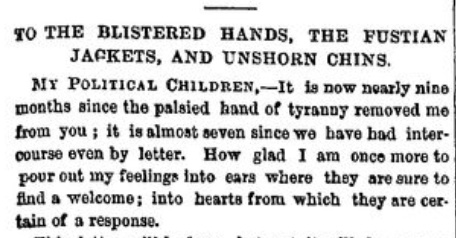
The first issue of the Northern Star was sold on Market Street, Briggate, on Saturday 18th November 1837. Its first edition was of 3000 issues, situated between the offices of the much more established Leeds Mercury, run and edited by the Baines family of Leeds, and the Leeds Intelligencer, around the corner from the Leeds Commercial Library, the Leeds Literary and Philosophical society, with a direct route to Kirkgate market.
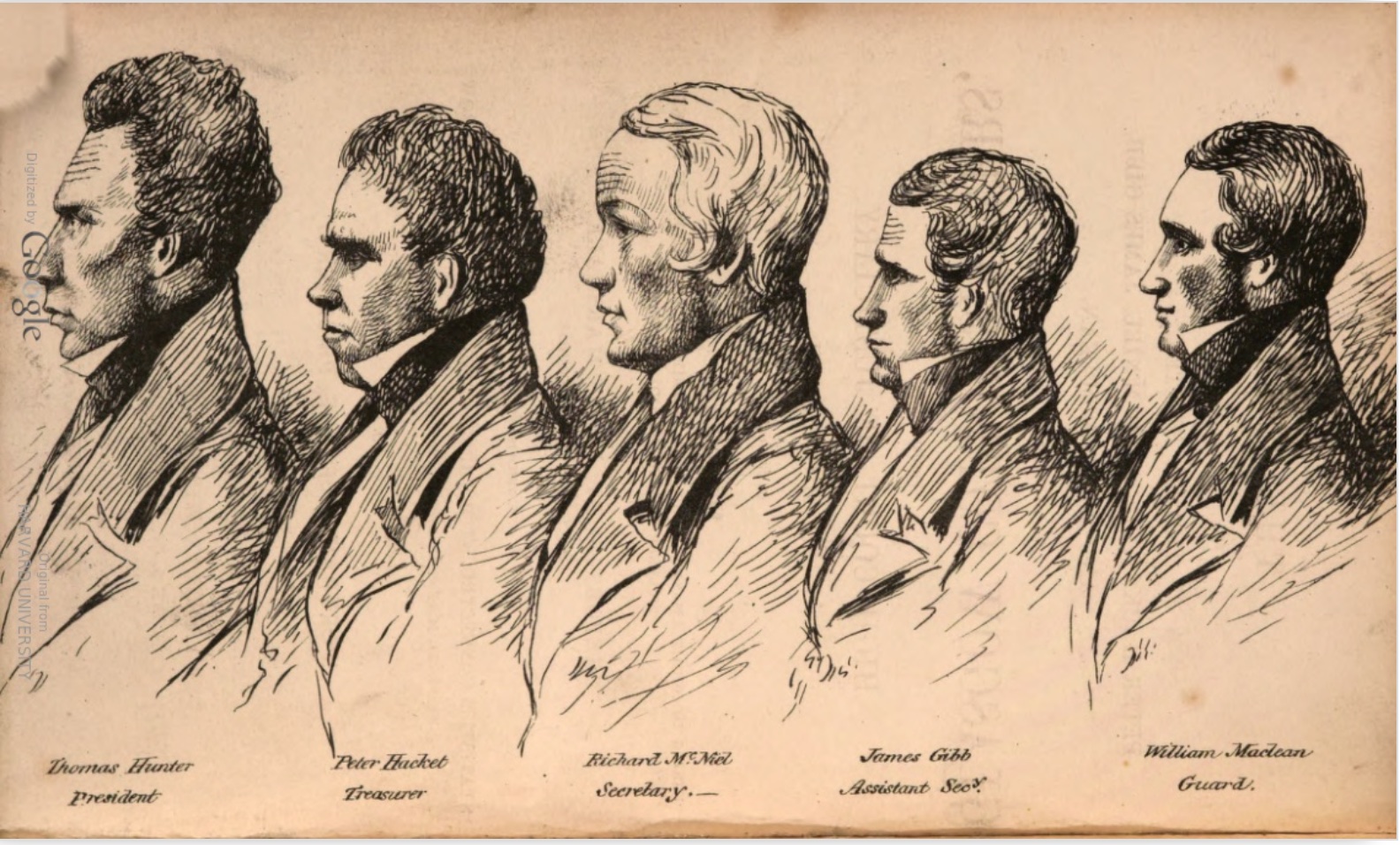
Its proprietor Feargus O’Connor had been attending the trial of six Glaswegian cotton spinners – their crime was leading strike action over a reduction in their wages.1 Returning to Leeds at 3am on Wednesday 15th November, with 3000 sheets of paper in hand, and working with his team of compositors and printers tried his hand at the printing press for the first time to complete 3000 copies of the first issue on Friday night ready to sell the next day.2
The Northern Star was a unique paper. It became the organ of the Chartist movement, which argued for the six points of a vote for all men, secret ballots, removal of property qualifications for MPs, payment of MPs so working people could stand in parliament, equal electoral districts, and annual parliaments. It campaigned for the rights of working people: trade unionists, like the Glasgow cotton spinners; the right to vote; campaigning against child labour – because only children of poor families had to go out and work instead of attending school or playing. It spoke about abuses of power in the prison systems and workhouses which overwhelmingly penalised the poor. In 1837 these things were considered ‘political radicalism’ because they were not rights that we enjoy now.
Political newspapers weren’t a brand new idea – the Leeds Mercury had been active in the movement to abolish Transatlantic slavery in the late 18th century. But a newspaper that was this politically radical usually only survived a year or two, was based in London, or had to be either legal and expensive or illegal and cheap. In the late 1700s and past the Peterloo Massacre of 1819 laws were passed to increase tax on publications which carried news or current affairs; clamped down on seditious writings which might criticise the government, and on public meetings where people might talk about these things. Universal suffrage – or the right of everyone over the age of 18 to vote – wasn’t accomplished until 1928. The Northern Star was campaigning for this right 90 years earlier.
Despite all of these legal obstacles, despite not having the machinery to print on such a massive scale in Leeds, the Northern Star thrived. Feargus O’Connor, a trained lawyer and former Irish MP for County Cork hired Reverend William Hill, a preacher from Hull who decried the ‘Ungodly’ poor law and workhouse system as editor, and Huddersfield-born weaver Joshua Hobson to become his publisher. The paper was legal, making it a little expensive at 4 1/2d per weekly issue, but it could publish news about progressive political movements. Political organisations made up of working-class people wrote in from all over the country to share their discussions and concerns about politics, to share strategies for campaigning, to share poetry and songs, to fundraise for libraries and supporting the families of imprisoned protesters, to congratulate each other on small victories but also to bicker and enact political drama. The Northern Star was hugely successful. By 1838 it was comfortably outselling its neighbours, the Leeds Mercury, the Leeds Intelligencer, and the Leeds Times, and for one week in 1839 it outsold the Times! It shows how driven, literate, creative, and passionate working people were, and how they cared about their right to politics. It was a space where thousands of people across the country mobilised millions of signatures of petitions for the right to participate in Britain’s parliament, standing up for their own and others’ humanity.
The Northern Star was published on Market Street, Leeds, every Saturday for seven years. They made the most of radical booksellers in Leeds, the libraries, the textile weavers, the market traders, before it relocated to London on 30th November 1844. It finally folded in 1852.
Date: Thursday 27th February 2025
Time: 7pm GMT
Venue: The Swathmore Education Centre, Leeds
- See James Marshall, ‘The trial of Thomas Hunter, Peter Hacket, Richard M’Neil, James Gibb, and William M’Lean, the Glasgow cotton-spinners…’ (Edinburgh: William Tait, 1838). The Glasgow Cotton spinners were officially charged with murder and intention to assassinate. After being sentenced to transportation, they eventually only served three years on the prison hulks in the Thames before being pardoned. <https://catalog.hathitrust.org/Record/102962721>. ↩︎
- Feargus O’Connor, ‘O’Connor and the English People’, Northern Star, 16 Jan. 1841, p. 7. See also James Epstein, ‘Feargus O’Connor and the Northern Star‘, International Journal of Social History (1976), pp. 51-97; and Mark Crail, ‘The Northern Star – the paper that made Chartism’, Chartist Ancestors <https://www.chartistancestors.co.uk/northern-star-the-paper-that-made-chartism/>. ↩︎
 Dr Vic Clarke